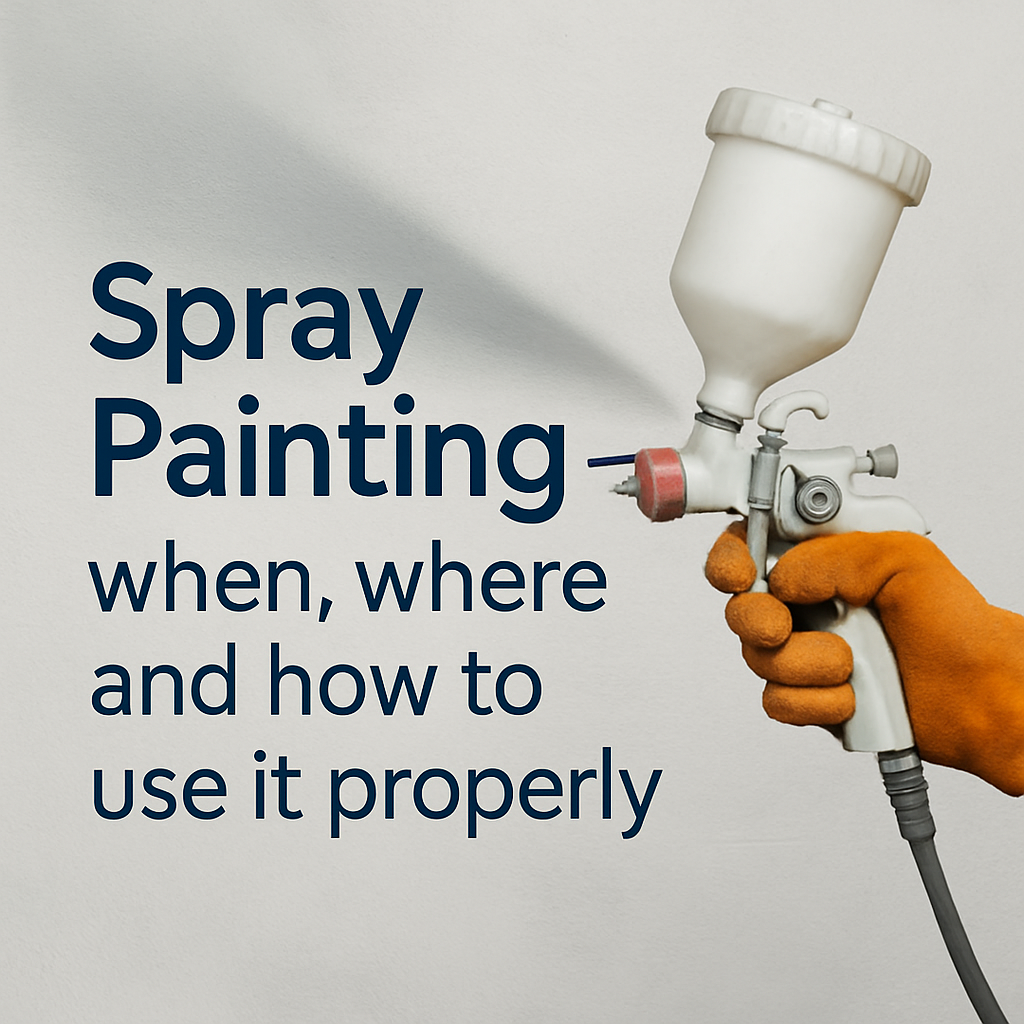
Spray painting – when, where and how to use it properly
Spray painting always looks quick and easy when you see it online – one sweep of the gun and the wall is covered in seconds. In reality, it’s not always that simple. Spray work can deliver an incredible finish, but it also comes with challenges that rollers and brushes don’t have.
The truth is, the spraying itself is often the shortest part of the job. What really takes time is the preparation. And if you cut corners there, you’ll spend more time fixing mistakes than you would have saved.
Here’s what you should know before you pick up a spray gun.
What is spray painting?
Spray painting is the application of paint using a spray gun – either an airless sprayer (high pressure, great for large surfaces) or an HVLP sprayer (high volume, low pressure, better for detail work).
It’s not the same as using a spray can from the DIY shop. Professional spray equipment uses pumps, hoses and nozzles to deliver a controlled, even coat across large areas or tricky surfaces.
In Ireland, spray work is common for:
- kitchen cabinet resprays,
- doors, skirting and trims,
- furniture pieces,
- large ceilings and walls,
- exterior facades.
What type of paint can you spray?
Not every paint is suitable for spraying. Some need to be thinned or filtered before they’ll run through the machine.
Emulsion / latex – for walls and ceilings.
Satin or gloss finishes – for woodwork, doors, cabinets, radiators.
Special coatings – anti-rust, weatherproof exterior paints.
Always check the manufacturer’s instructions. Some paints are designed with rollers in mind and will clog your sprayer unless prepared properly.
Preparing properly before spraying
If there’s one rule to spray work, it’s this: prep is everything.
- Protective gear – A proper mask (rated for fine particles), goggles, and sometimes a disposable suit. Paint mist is invisible but it gets into your lungs quickly if you’re not careful.
- Covering and masking – Floors, windows, sockets, switches, even radiators need to be wrapped. Overspray travels further than most people expect.
- Mixing and filtering – Many paints need to be strained to remove lumps. One tiny bit of grit can block the nozzle.
- Ventilation – Even with a mask, you want good airflow in the room.
It sounds like a lot, and it is. But without it, you’ll spend hours cleaning paint dust off things you didn’t mean to paint.
When spray painting makes sense – and when it doesn’t
Spray is perfect for:
- Large ceilings and open-plan walls – the speed and even finish are unmatched.
- Kitchen cabinets and furniture – you get that smooth, factory-like look.
- Exterior facades – textured walls, rough render, or large surfaces.
Spray isn’t ideal for:
- Small touch-ups – a roller is faster and tidier.
- Rooms with lots of detail or obstacles – masking takes longer than the painting itself.
- Jobs where you can’t fully protect the surroundings – overspray is unforgiving.
Costs and pricing
People sometimes assume spray painting is cheaper because it looks quicker. In practice, the cost is often similar to traditional methods, because of the prep involved.
- Interiors: around €12–15 per m² (depending on condition and coats).
- Exteriors: around €15–20 per m², especially if scaffolding is needed.
- Kitchen cabinets respray: typically €1,200–€2,000 for an average kitchen.
The value isn’t necessarily in saving money – it’s in the finish. A sprayed kitchen looks brand new, not repainted.
Common mistakes with spray work
- Not masking properly – everything gets a fine dusting of paint.
- Spraying too close – leaves heavy runs and drips.
- Spraying too far – leaves a dry, patchy texture.
- Ignoring drying times – ruins the smooth finish.
Most of these can be avoided with patience and practice.
A quick checklist
✔️ Mask and cover everything twice as carefully as you think you need
✔️ Wear a proper mask and goggles
✔️ Dilute and strain the paint if required
✔️ Test your spray pattern on cardboard first
✔️ Keep the same distance and speed throughout
Spray painting is a fantastic tool, but like any tool, it has its place. It’s not about replacing rollers and brushes – it’s about knowing when spray is the right choice.
If you get the prep and technique right, spray can give you a finish that brushes and rollers can’t match. If you rush or skip steps, it’ll cause more hassle than it’s worth.
And if you’re not sure whether spray is the right option for your project, ask a professional for advice. Sometimes a roller will do the job perfectly. Other times, spray work is the difference between good and flawless.
FAQ — Commercial Painting Dublin
1. Why does spray paint sometimes crack or wrinkle when I apply another coat?
This usually happens because the first coat was applied too thick, causing the surface to dry before the layers beneath. When recoated too soon—or at the wrong temperature—the solvents in the paint shrink and lead to wrinkling or cracking.
Tip: Always apply light, even coats. Spray within the recommended temperature (roughly 65–85 °F / 18–29 °C) and follow the recoat time — often 30–60 minutes or wait 24–48 hours if needed
2. Can I spray paint on weird materials like Styrofoam or glossy plastic?
Be cautious—many spray paints contain solvents that can dissolve Styrofoam, and glossy plastics can repel paint. The fix? Lightly scuff the surface with fine sandpaper so the paint can grip, and always check compatibility first
3. Why is the finish grainy or sandy when I spray in hot or bright conditions?
If spray paint dries too quickly mid-air (due to heat or sunlight), it won’t level well, resulting in a rough, sandy feel.
Tip: Spray in cooler parts of the day—morning or evening—and keep the can or gun at a distance of about 8–16 inches (20–40 cm). This ensures the paint lands wet and smoothes out on the surface
4. How long should I wait between coats, and how long until it’s fully cured?
Drying and curing are not the same. Many brands are touch-dry within 20–25 minutes (Krylon, for example), but the paint may take days or even weeks to fully cure and become durable. If you recoat too soon, you risk wrinkling or poor adhesion. Always follow the can’s instructions for dry and recoat times; most recommend waiting at least 24–48 hours for full curing